

In the whirlwind of American politics, few figures have stirred up as much debate as Donald Trump. His victories, especially in the 2016 election, left many scratching their heads and others cheering from the rooftops. But just how much did he win by? Spoiler alert: it’s more than just a number; it’s a tale of strategy, passion, and a touch of that classic Trump flair.
Overview of Trump’s Election Victories
Donald Trump achieved significant electoral victories in the 2016 and 2020 elections. In 2016, he won the presidency with 304 electoral votes against Hillary Clinton’s 227. Trump’s victory margin in the Electoral College underscored his success, though he lost the popular vote by approximately 2.9 million votes.
During the 2020 election, Trump faced Joe Biden. Once again, he secured a substantial number of electoral votes, obtaining 232 compared to Biden’s 306. The popular vote continued to trend in Biden’s favor, with Trump receiving roughly 74 million votes to Biden’s 81 million.
Support for Trump showed notable geographical patterns. Key battleground states like Pennsylvania, Wisconsin, and Michigan played critical roles in his 2016 win. A combination of working-class support and strong turnout in rural areas contributed to this success. Regional dynamics shifted in 2020, however, as Biden regained ground in many of these states.
The significance of Trump’s election victories lies in their implications for party dynamics. His ability to galvanize a loyal base shifted the Republican Party’s stance on various issues. The 2016 campaign also demonstrated the potency of social media as a campaign tool, reshaping how candidates engage voters.
Understanding the percentages and contexts of these victories reveals the broader trends in American politics. Trump’s unexpected success highlighted divisions within the electorate, prompting ongoing discussions about the future direction of political parties in the United States.
2016 Presidential Election Results
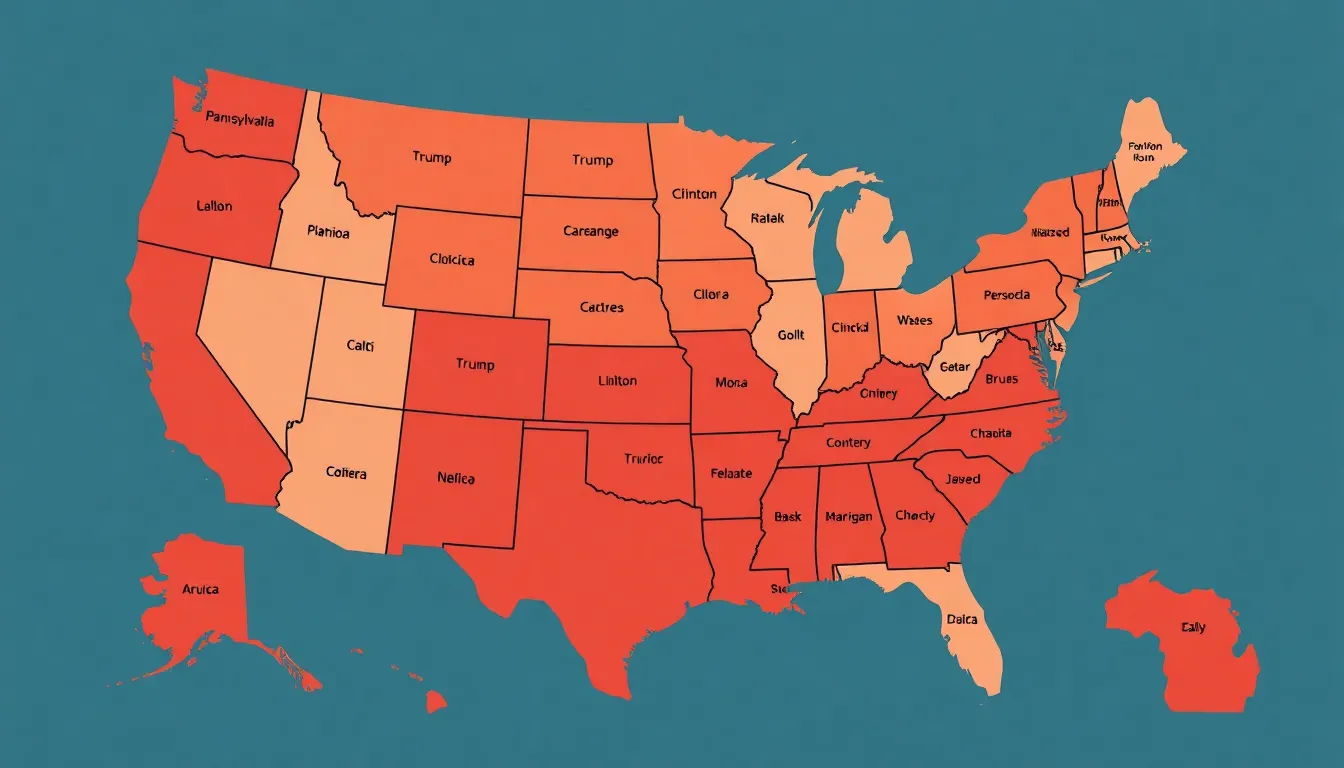
The 2016 presidential election delivered surprising outcomes, revealing key voting trends and shifts across the United States. Donald Trump won the presidency, but the details behind the numbers hold significance.
National Vote Percentage
Trump secured 46.1% of the national popular vote in 2016. In comparison, Hillary Clinton received 48.2%. This resulted in a gap of approximately 2.9 million votes, with roughly 65.8 million votes for Clinton and about 62.9 million for Trump. Despite losing the popular vote, winning the Electoral College was critical for Trump’s victory, underscoring the complexities of the election.
Electoral College Breakdown
In the Electoral College, Trump achieved a total of 304 votes, while Clinton garnered 227. Notably, Trump flipped several key battleground states. He won Pennsylvania, Wisconsin, and Michigan, which had previously leaned Democratic in previous elections. Each state’s contribution to the Electoral College proved vital for Trump’s success. The broader electoral strategy involved appealing to working-class and rural voters, illustrating important demographic divides within the electorate.
2020 Presidential Election Results
The 2020 Presidential Election showcased significant shifts in voter preferences. Joe Biden won decisively, capturing 306 electoral votes compared to Donald Trump’s 232.
National Vote Percentage
Biden garnered approximately 51.3% of the national popular vote, while Trump secured around 46.8%. The popular vote margin was roughly 4.5 million in favor of Biden. This election marked a shift from 2016, with Biden achieving strong support in urban areas. Voter turnout reached historic levels, with about 159 million Americans participating in the election. Diverse demographics significantly influenced the voting patterns, as suburban areas swung more towards the Democratic candidate.
Electoral College Impact
The Electoral College proved pivotal in determining the outcome. Biden’s 306 electoral votes represented a comfortable lead over Trump’s 232. Key battleground states like Arizona, Georgia, Michigan, Pennsylvania, and Wisconsin ultimately swung toward Biden. Each state’s voting trends revealed changing demographics and shifting political alliances. The results emphasized the importance of winning critical electoral votes over merely accumulating a popular vote.
Comparison of Election Percentages
Election percentages reflect the dynamics of American politics. Data from 2016 and 2020 reveals pivotal changes in voter sentiment.
2016 vs. 2020
Trump’s electoral success in 2016 contrasted sharply with his 2020 defeat. Securing 304 electoral votes, he lost the popular vote by approximately 2.9 million. His support constituted around 46.1% of the national popular vote. In stark contrast, Biden gained 306 electoral votes in 2020 and achieved 51.3% of the popular vote, resulting in a favorable margin of 4.5 million votes.
Factors Influencing Vote Percentages
Key factors shaped the voting outcomes in both elections. Changes in demographics influenced voting patterns, particularly in urban areas, leading to a shift in preferences toward Biden in 2020. Trump’s appeal remained strong in rural counties, though it did not sway enough voters to secure his re-election. Strategies like social media engagement defined the 2016 campaign, allowing Trump to reach a diverse audience. In 2020, however, heightened voter mobilization efforts and increased turnout indicated a more engaged electorate, impacting final percentages significantly.
Analysis of Voter Demographics
Understanding the demographics that influenced voter behavior in the 2016 and 2020 elections provides insight into shifting political landscapes.
Key Demographics in 2016
In 2016, Trump garnered significant support from white working-class voters, especially in rural areas. Approximately 62% of white voters backed him, while only 29% of Hispanic voters and 19% of Black voters supported his campaign. Notably, he excelled in states like Pennsylvania, Wisconsin, and Michigan, where these demographics made substantial contributions to his victory. Voter enthusiasm in these areas often stemmed from concerns about trade and job security.
Women represented a crucial voting block, yet 53% favored Clinton. Trump’s ability to connect with disaffected voters in these states showcased the impact of local issues and economic anxieties. These dynamics proved pivotal in securing Trump’s electoral victory.
Key Demographics in 2020
The 2020 election demonstrated a noticeable shift in voter demographics. Biden’s campaign appealed strongly to urban populations, with 87% of Black voters and 65% of Hispanic voters supporting him. Biden captured crucial battleground states, including Arizona and Georgia, reflecting substantial changes in voter preferences.
Suburban women emerged as a decisive group, with many moving away from Trump’s Republican base. Furthermore, overall voter turnout reached historic levels, with about 159 million Americans participating. This engagement illustrated a growing awareness of social issues, influencing Biden’s ability to mobilize diverse voter groups effectively.
Trump’s electoral journey underscores the complexities of American politics. His 2016 victory, achieved through a strategic appeal to key demographics, showcased a unique ability to connect with disenchanted voters. However, the 2020 election revealed shifting sentiments as Biden captured a larger share of the popular vote and critical battleground states.
These outcomes reflect not just numbers but evolving political landscapes and voter priorities. The stark contrasts between the two elections highlight the dynamic nature of voter behavior and the implications for future political strategies. As discussions continue about the direction of the Republican Party and broader electoral trends, Trump’s influence remains a pivotal topic in understanding contemporary American politics.


